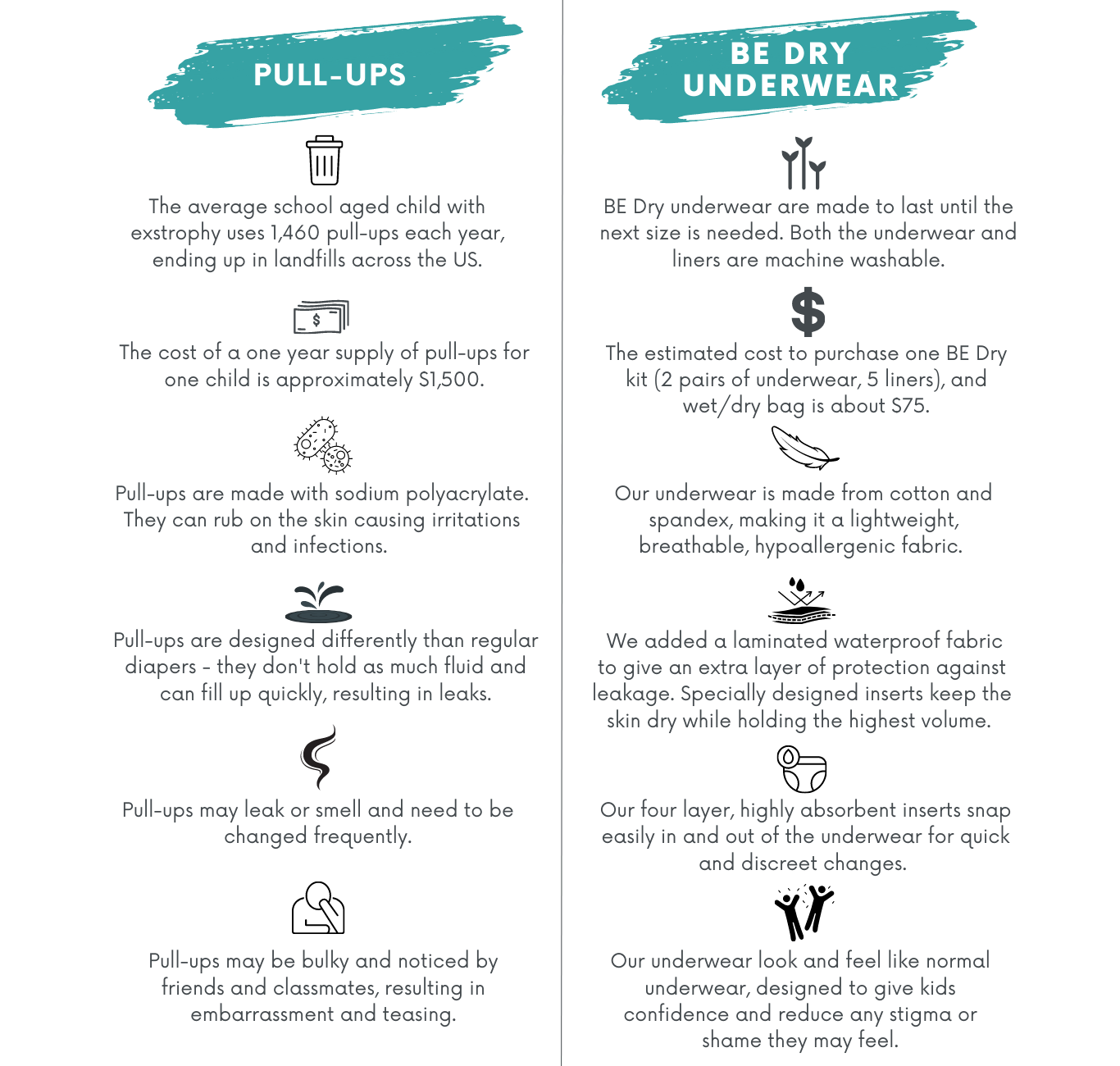
School aged children with BE have to wear diapers, or worse, not attend school at all.

BE-DRY®: Improving Continence, Dignity, and Education for Children with Bladder Exstrophy
BE-DRY® is a first-of-its-kind, reusable continence underwear program developed and led by the Association for the Bladder Exstrophy Community (A-BE-C).
The program was created to address the daily challenges faced by children living with bladder exstrophy—particularly the impact of urinary incontinence on education, dignity, and social inclusion.
Bladder exstrophy is a rare and complex congenital condition that often requires multiple surgeries over many years. Despite successful reconstruction, many children continue to experience urinary leakage during childhood, which can prevent them from attending school consistently and participating fully in daily life.
BE-DRY provides a practical, dignified alternative to disposable diapers and pull-ups—allowing children to remain in school, reduce stigma, and maintain self-confidence.
⸻
Program Development & History
The BE-DRY program was initiated by A-BE-C in 2017 after identifying the lack of washable, reusable continence solutions suitable for school-aged children with bladder exstrophy.
Over the past 11+ years, A-BE-C has led the research, design, prototyping, manufacturing, funding, and international distribution of BE-DRY—investing over $50,000 USD in product development, testing, branding, and global deployment.
Key milestones include:
•2017: Identification of unmet continence needs for school-aged children
•2018–2019: Fabric research, design development, and prototyping
•2020–2022: COVID-related pause in manufacturing and distribution
•2023: First production run and distribution in India and Uganda
•2024–2025: Ongoing clinical evaluation and research initiatives in the U.S.
⸻
About BE-DRY Underwear
BE-DRY underwear is designed specifically for children living with bladder exstrophy and other conditions resulting in chronic urinary incontinence.
Features include:
•Reusable and washable design
•Modular system with replaceable absorbent inserts
•Skin-safe, breathable, and discreet materials
•Cost-effective and sustainable for low-resource settings
•Designed to look and feel like regular underwear
The modular design allows families to reuse the underwear while replacing only the absorbent pads as needed—making BE-DRY both affordable and scalable.
⸻
Global Collaboration
BE-DRY is implemented through collaboration with pediatric urology teams, hospitals, manufacturing partners, and philanthropic supporters internationally.
Clinical and implementation partnerships include:
•Pediatric urology teams at Civil Hospital, Ahmedabad
•The International Bladder Exstrophy Collaborative (IBEC)
•Manufacturing partners supporting sustainable production
•Individual and family donors supporting patient dignity and access
A-BE-C remains the originator, program lead, and steward of BE-DRY.
⸻
Program Leadership
BE-DRY is led by Pamela Artigas, Executive Director of A-BE-C and parent of a child born with bladder exstrophy. Her lived experience informs the program’s focus on dignity, education access, and long-term quality of life for children and families.
⸻
Looking Ahead
Some individuals with bladder exstrophy experience urinary leakage well into adolescence and adulthood. Addressing continence early—especially during school-age years—is critical to ensuring education access, emotional well-being, and long-term independence.
BE-DRY represents A-BE-C’s commitment to addressing not only surgical outcomes, but the everyday realities children face while growing up with bladder exstrophy
BE-DRY® Attribution & Use Policy
BE-DRY® is a proprietary program developed and led by the Association for the Bladder Exstrophy Community (A-BE-C).
Bladder exstrophy is a rare and initially devastating birth condition. The bladder is split in half and turned inside out. The skin that covers the bladder does not form properly, exposing the bladder to the external world. Repair of the exposed bladder requires surgical reconstruction and while most patients will never achieve normal continence, with good quality care, and catheterization they can live normal lives.
Unfortunately, this is a different story for people in third world countries. Procedures for continence are rarely done and supplies are limited, so patients with exstrophy are left ‘wet.’ With no access to disposable diapers, they wear nothing, soaking the ground or wrap themselves with rags. They cannot go to school and often don’t play with other children, leaving them socially isolated and vulnerable.
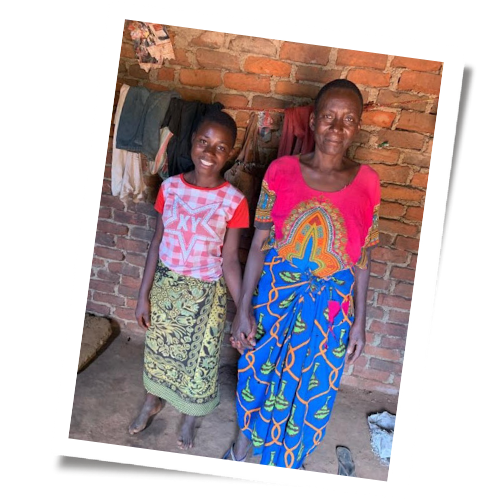
Annett is a 15-year year old girl who has had surgery to reconstruct her bladder, however she is still ‘wet’. She always has a puddle of urine under her feet. She’s made several mats out of straw to sit on and replaces them as they get wet with urine. She has never gone to school because of her condition however, she has dreams of one day attending a vocational school where she can learn to sew. Unfortunately, this will not happen until there is a solution to keep her dry throughout the day.
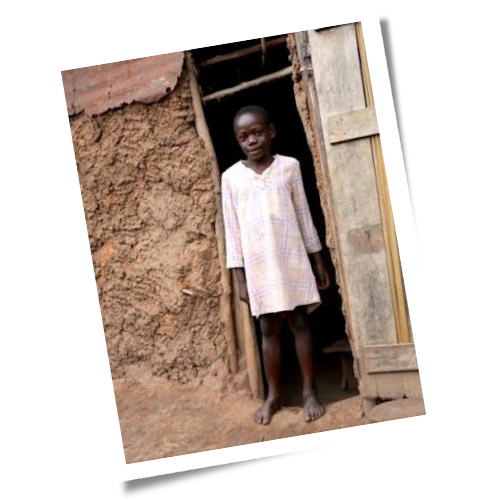
Johnson often wears a dress so he does not “soak” his clothes. Johnson is eight years old and lives in a remote village, with no access to disposable diapers. With nothing to keep him dry and a steady flow of urine leaking from a hole just below his belly button, his legs are wet and a puddle is always beneath him. School isn’t an option so he is confined to his small mud hut or close by where others won’t see and tease him. Imagine the confusion and shame this young boy feels.